Choosing a manufacturer starts with the approved meter arrangement, not a catalogue box or a nominal internal volume. You will be able to define the enclosure correctly, test supplier claims against utility and IEC requirements, and compare construction, finish, protection, and long-term outdoor performance before requesting quotations.
Key takeaways
- Measure the exact meter family, terminals, cable route, and clearances.
- Verify Maharashtra utility approval before commissioning a custom box design.
- Compare deep-drawn, fabricated, and molded enclosures against site conditions.
- Request complete-box evidence for IP rating, impact, safety, and finish.
Define the box around the meter, terminals, and cable route
1. Specify the meter-box size from the exact meter family, not from a generic internal volume. Record the meter envelope, including body width, height, depth, mounting-hole pattern, terminal-cover projection, display location, and the utility’s required clearances around each face. Confirm that the approved mounting arrangement leaves the display readable with the door closed.
2. Draw the complete terminal and cable path before requesting quotations. Mark the terminal arrangement, service fuse, neutral link, incoming and outgoing entry points, gland or knockout sizes, sealing-wire points, and the cable bend radius for the largest conductor.
Include space for terminal-cover removal; a cable route that fits on paper can prevent safe termination in practice.
3. State the internal clearances and installation conditions in the specification. Allow room for conductor dressing, inspection, tightening tools, and protective bonding. Ask for a temperature-rise calculation, test basis, or installation derating using the actual meter, terminals, conductor load, solar exposure, and ventilation conditions; a box that fits can still overheat.
4. Define the finished assembly, not merely the shell. Specify the required IP rating under IEC 60529 and require confirmation that it covers the door seal, viewing window, lock, cable glands, and unused knockouts.
Require a dedicated earth stud or bar, door-bond continuity across coated joints, and controlled hole position, flatness, burr removal, bend accuracy, and coating buildup so the meter seats, the gasket compresses, and the door closes. If the box contains busbars or protective devices, ask which IEC 61439 verification obligations apply.
Confirm Maharashtra utility approval before ordering a design
Ask the Maharashtra electricity distribution utility for the current approved meter-box design, installation drawing, or written acceptance before placing a purchase order. A manufacturer’s statement that its box is “standard” does not prove acceptance at your subdivision or inspection office.
1. Identify the exact meter family, manufacturer, and variant that will be installed. Compare its envelope, terminal orientation, terminal-cover clearance, display position, and mounting holes with the proposed drawing.
2. Check the approved mounting arrangement, including service-fuse and neutral-link locations, cable-entry position, conductor bending space, and the minimum clearance around live terminals. Internal volume alone is not evidence of compatibility.
3. Mark every required sealing point on the drawing: meter cover, terminal cover, door, cable-entry plate, and any inspection access. Confirm that each point remains reachable after wiring and that breaking the seal reveals access.
4. Obtain the local inspection rules in writing from the utility or its authorised representative. Ask whether the window, lock, hinge arrangement, blanking plates, enclosure material, and cable glands meet its installation practice.
5. Record the drawing number, revision, approval date, and approved meter configuration in your purchase specification. Require a production sample to match that controlled drawing; a later substitution can invalidate acceptance.
Do not treat IEC 62208 or an IEC 60529 IP rating as utility approval. Those standards support enclosure performance, while the Maharashtra electricity distribution utility decides whether the complete installed arrangement passes its inspection.
Compare deep-drawn, fabricated, and molded enclosure construction
Tooling cost and production volume usually decide the first cut: a deep-drawn meter box suits repeatable, high-volume production, while a fabricated enclosure suits variable designs or smaller batches. A molded enclosure becomes attractive when low weight, insulation, and corrosion resistance outweigh tooling and approval constraints.
| Process | Best fit | Trade-offs |
|---|---|---|
| Deep-drawn metal | High production volume with one established meter-box shape | Fast repeat production and good rigidity, but dies make late dimensional changes expensive. Repair usually means replacing the box or correcting local damage. |
| Fabricated enclosure | Low to medium production volume, custom cable entries, mounting plates, or utility-specific layouts | Easy to modify, repair, and produce without major tooling. Welding, seams, and cut edges demand disciplined corrosion protection; unit cost rises with labor. |
| Molded enclosure | High volume where an approved polymer design needs electrical insulation, low weight, and resistance to atmospheric corrosion | Tooling is expensive, repairs are difficult, and UV stability, impact performance, flammability, and dimensional compatibility require evidence. Custom changes can require a new mold. |
Select a deep-drawn meter box when its tooling cost is spread across a stable production volume and the design will not change. Choose a fabricated enclosure when the meter family, terminal orientation, or cable route is still changing. Choose a molded enclosure only after the utility accepts the material and mounting arrangement.
Whichever process you choose, demand evidence for the complete assembled box: IEC 60529 ingress protection with seals, window, glands, lock, and unused knockouts installed; IEC 62208 construction performance; and thermal suitability with the actual meter and terminals. A strong shell alone proves none of these.
Audit the manufacturer’s metalwork, finish, and environmental protection
A reliable outdoor meter-box manufacturer proves an enclosure system, not merely a folded shell. Ask for construction details, controlled tolerances, finish specifications, bonding methods, and evidence against IEC 62208, which covers mechanical strength, insulation properties, temperature rise, and corrosion resistance for empty low-voltage enclosures. Overall dimensions alone do not ensure meter seating or door closure.
Request these acceptance characteristics on the drawing and inspection plan:
- Sheet thickness and tolerances, flatness, hole position, bend allowance, burr removal, and weld-distortion limits.
- Galvanized steel with a defined zinc-coating designation, including repair of cut edges, punched holes, welds, and fastener interfaces.
- Powder-coated mild steel with documented pretreatment, coating thickness, adhesion requirements, and protected mating surfaces.
- Stainless steel with a stated grade and finish when the site demands greater corrosion resistance; “stainless” alone is not a specification.
- A gasketed door, controlled latch and seal geometry, and an earth stud or bar that maintains continuity across painted or powder-coated joints.
IEC 60529 IP results address ingress, not atmospheric or galvanic corrosion. Demand a separate corrosion test or service-environment rationale. For Param Controls, ask for the protective-earth path and proof that exposed metal remains bonded after coating and assembly.
If the box contains terminals or busbars, require the manufacturer to state whether IEC 61439 design and routine verification applies. Steel thickness alone proves no short-circuit performance.
Related product
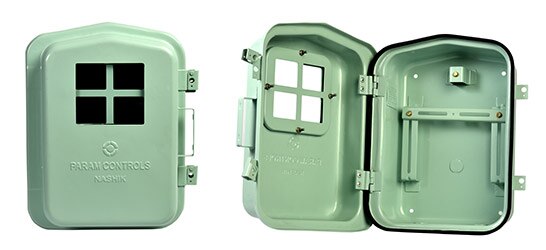 | Single Phase Deep Drawn Metal Meter Box Durable & Precisely Manufactured Meter Boxes for Single-Phase Applications Param Controls manufactures and supplies Single Phase Deep Drawn Metal... View product → |
Demand evidence for IP, impact, safety, and complete-box performance
A test report for a bare shell does not prove that the installed meter box will protect equipment or people. Demand documents that identify the exact assembled configuration, including the door, seals, viewing window, cable glands, lock, terminals, and unused knockouts.
Ask for evidence covering these checks:
- IEC 60529 IP testing on the complete box, with the tested rating stated for the actual closed and cable-entry configuration. An empty knockout or poorly sealed gland can reduce the finished installation’s protection.
- IEC 62262 impact testing for the enclosure and transparent window, not just the metal panel. Confirm that the window remains retained and sealed after impact and repeated door operation.
- IEC 62208 evidence for the empty enclosure’s construction, mechanical strength, insulation, temperature-rise basis, and corrosion resistance.
- IEC 61439 design verification and routine-verification records when the box contains busbars, service terminals, protective devices, or other low-voltage assembly functions. Do not infer short-circuit performance from sheet thickness.
| Document or design check | What it must establish | What it does not establish |
|---|---|---|
| IEC 60529 report | Ingress protection of the completed box | Atmospheric or galvanic corrosion resistance |
| IEC 62262 report | Impact rating of metalwork, door, and window | Long-term UV durability |
| Thermal calculation or test | Temperature with the actual meter, conductors, terminals, solar gain, and installation conditions | Safe performance with a different layout |
Require a defined coating or material system and separate corrosion-test evidence or service-environment rationale. Specify window UV resistance, condensation resistance, viewing-angle readability, and retention. A box that fits the meter can still overheat in direct sun or restricted ventilation.
Frequently asked questions
What dimensions must you define before ordering a single-phase meter box?
Record the meter’s width, height, depth, mounting-hole pattern, terminal-cover projection, display position, cable route, and utility clearances. Confirm the display remains readable with the door closed.
Why must you confirm Maharashtra utility approval before selecting a manufacturer?
The utility can require a specific enclosure arrangement, sealing provision, mounting method, clearances, or approved design. Confirm those requirements before paying for tooling or production.
How do deep-drawn, fabricated, and molded meter boxes differ?
Deep-drawn metal boxes offer a formed shell with fewer joints, fabricated boxes allow flexible dimensions and features, and molded enclosures provide non-metallic construction. Compare them by fit, strength, corrosion exposure, modification needs, and utility acceptance.
What should you audit in a meter-box manufacturer’s metalwork and finish?
Inspect sheet thickness control, bend accuracy, weld quality, edge treatment, door alignment, hinge and lock fit, coating preparation, finish uniformity, drainage, and corrosion protection.
Which test evidence should a manufacturer provide for the complete meter box?
Ask for evidence covering the stated IP rating, impact resistance, electrical safety, earthing continuity where applicable, material and coating performance, and tests performed on the assembled box rather than isolated parts.